What is the average cost of a home equity loan?
 Isabella Floyd
The average closing costs on a home equity loan or HELOC will usually amount to 2% to 5% of the total loan amount or line of credit, accounting for all lender fees and third-party services.
How Much Are Closing Costs for Home Equity Loans and HELOCs?
| Closing Cost | Average Cost |
|---|---|
| Full appraisal fee | $475-$1,000+ |
Thereof, what are typical closing costs for a home equity loan?
Home equity loan closing costs and fees. Although costs and fees vary from one lender to another, closing costs for a home equity loan typically range anywhere from 2% to 5% of the loan, although some banks may pick up a share or waive them altogether.
Furthermore, are Home Equity Loans Worth It? A home equity loan or line of credit can be a great option for dealing with debts and other financial items that need attention, but sometime it is not the smart way to go. People took out home equity loans and lines of credit only to end up owing more money on their home than what it was worth.
Also Know, what is the current interest rate on a home equity loan?
5.82%
How do you calculate a home equity loan?
To determine how much you may be able to borrow with a home equity loan or HELOC, divide your mortgage's outstanding balance by the current home value. This is your LTV. Depending on your financial history, lenders generally want to see an LTV of 80% or less, which means your home equity is 20% or more.
What is a good rate on a home equity loan?
Current home equity loan interest rates range between 3.75percent and 11.99 percent depending on the lender, loan amount and creditworthiness of the borrower. Our list of the best home equity loans for 2020 can help you decide which loan might work best for your needs.Do you need a home appraisal for a home equity loan?
Do all home equity loans require an appraisal? In a word, yes. The lender requires an appraisal for home equity loans—no matter the type—to protect itself from the risk of default. If a borrower can't make his monthly payment over the long-term, the lender wants to know it can recoup the cost of the loan.Does a home equity loan hurt your credit score?
Yes, home equity lines of credit (HELOC) can have an impact on your credit score. It also depends on your overall financial situation and ability to make timely payments on any amount you borrow via your home equity line of credit. Find out more about how a HELOC affects a credit score.How long does it take to get approved for a home equity loan?
14 to 28 days
What are the disadvantages of home equity loans?
Disadvantages of a Home Equity Loan- Risk:Your home is the collateral.
- Going Underwater:If you tap into your home's equity, and later its value declines, you could owe more on your home than it's actually worth.
- Closing Costs and Fees:Home equity loans can serve as a second mortgage.
Can you pay off a home equity loan early?
Prepayment PenaltiesVery often, home equity loans include a prepayment penalty as part of the lending agreement. According to Bankrate, lenders expect borrowers to carry an outstanding loan balance for at least two or three years. The penalty is a fee the lender charges for early repayment.What can I use home equity loan for?
A HELOC or home equity loan can be used to consolidate high-interest debts to a lower interest rate. Homeowners sometimes use home equity to pay off other personal debts such as a car loan or a credit card.What credit score do I need to get a home equity loan?
To qualify for a home equity loan, here are some minimum requirements: Your credit score is 620 or higher — 700 and above will most likely qualify for the best rates. You have a maximum loan-to-value ratio, or LTV, of 80 percent — or 20 percent equity in your home. Your debt-to-income ratio is 43 percent to 50 percent.What is the current interest rate?
Today's Mortgage and Refinance Rates
| Product | Interest Rate | APR |
|---|---|---|
| 30-Year Fixed Rate | 3.680% | 3.740% |
| 20-Year Fixed Rate | 3.500% | 3.570% |
| 15-Year Fixed Rate | 3.170% | 3.250% |
| 10/1 ARM Rate | 3.750% | 3.940% |
Which is better cash out refinance or home equity loan?
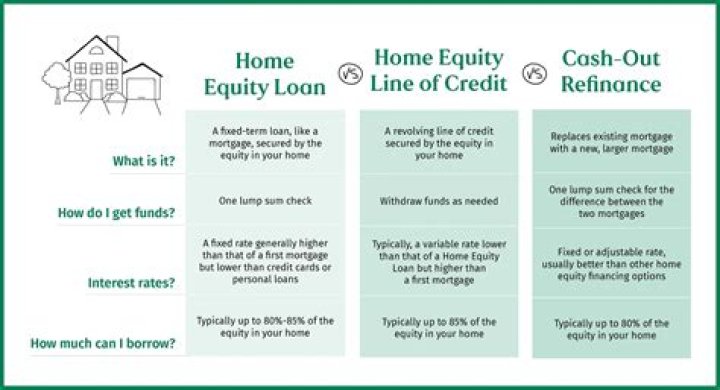
Typically, home equity loans and lines come with higher interest rates than cash-out refinances. They also tend to have much lower closing costs. So if a new mortgage rate is similar to your current rate, and you don't want to borrow a lot of extra cash, a home equity loan is probably your best bet.Can you use a home equity loan for anything?
Technically, you can use a home equity loan to pay for anything. However, most people use them for larger expenses. Here are some of the most common uses for home equity loans. Remodeling a Home: Payments to contractors and for materials add up quickly.How can I get a home equity loan with high debt to income ratio?
There are ways to get approved for a mortgage, even with a high debt-to-income ratio: Try a more forgiving program, such as an FHA, USDA, or VA loan.
Get approved with a high DTI
- Try a more forgiving program.
- Restructure your debts.
- Pay down (the right) accounts.
- Cash-out refinancing.
- Get a lower mortgage rate.